On the 250th anniversary of America’s founding, we should remember the indispensable role of the Holy Bible in the creation of the nation. Dr. Os Guinness once said that “the Biblical concept of covenant gave rise to the U.S. Constitution.” And we could add to that, the Declaration of Independence. In fact, the late Dr. Donald S. Lutz of the University of Houston wrote a great book called The Origins of American Constitutionalism.
In that 1988 volume, he demonstrates how the Declaration and especially Constitution were influenced by state constitutions. When Dr. Lutz first began to study the Constitution and its sources many years ago, he began to see that its roots lay in the earlier Puritan covenants which, in turn, got back to the teaching about covenants in the Bible.
Lutz writes, “The American constitutional tradition derives in much of its form and content from the Judeo-Christian tradition as interpreted by the radical Protestant sects to which belonged so many of the original European settlers in British North America.”
And he adds, “Indeed, the concept of federalism—the creation of a new unified entity that is indissoluble yet preserves the freedom and integrity of its constituent parts—derives from the biblical notion of covenant, which the dissenting Protestant colonists understood so well.”
In fact, these are just a few examples of how the Bible is what I call “the book that made America.” In fact, I wrote a book on the subject with that very title.
The Bible’s Effect on Society
The Bible was influential not only in terms of the form of government, but in terms of society itself. For the first couple of centuries of colonial and early American education, the Bible was the chief textbook in one way or another. Even the ABCs taught biblical truths, as seen in the New England Primer of 1690, which went through many reprints. Many of the Founding Fathers were taught to read using this small textbook.
They learned, “A-In Adam’s fall, we sinned all. B-Thy life to mend, the Bible tend. C-Christ crucified, for sinners died,” and so on. The most common version of the Bible in the American experience was the King James Version (1611).
Our Nation’s First Complete English Bible
During the American War for Independence, our fledgling country began to run out of Bibles. These had been printed in England, but we were at war with same, so plans were developed to print copies of the Bible here in America, with the explicit aid of Congress.
If you walk around the Society Hill section of Philadelphia today, right next to Shane’s Confectionary, an amazing homemade candy store, you’ll see an historical marker related to this published-in-America Bible plan.
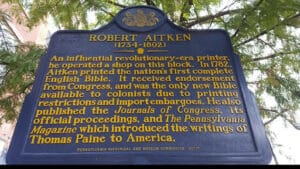
Historical marker in Philadelphia about the Aitken Bible (Photo by Jerry Newcombe)
I learned about this historical marker thanks to Dr. Peter Lillback, founder of Providence Forum (which he generously donated to Coral Ridge Ministries, and for which I serve as executive director). Dr. Lillback was a driving force in having the city install this important marker in 2011.
In his book, America’s God and Country, historian Bill Federer writes of the “Congress of the Confederation (September 10, 1782)”:
In response to the need for Bibles, Congress endorsed Robert Aitken of Philadelphia to print a Bible. Robert Aitken was the publisher of The Pennsylvania Magazine, as well as the Journals of Congress. In colonial America, it was illegal to print the Bible without a license from the King, and the King had only granted licenses to printers in England. When the Revolutionary War interrupted trade with the King’s authorized printer of the King James Authorized Bible, there was a shortage in America of Bibles, which were used in courts of justice, churches, schools, and the arts. On January 21, 1781, Robert Aitken had petitioned Congress for approval to print ‘a neat edition of the Holy Scriptures for the use of schools.’ Robert Aitken’s Bible became known as the Bible of the Revolution. The following Endorsement of Congress was printed on its front page.” (emphasis added)
Here is the Endorsement of Congress for the Aitken Bibles: “As Secretary of Congress, Charles Thomson signed the endorsement of Congress which authorized Robert Aitken to print the Bible, September 12, 1782:
Honble James Duane, Esq. Chairman, and the other Honble Gentlemen of the Committee of Congress on Mr. Aitken’s Memorial.
Whereupon, RESOLVED,
THAT the United States in Congress assembled highly approve the pious and laudable undertaking of Mr. Aitken, as subservient to the interest of religion, as well as an influence of the progress of arts in this country, and being satisfied from the above report of his care and accuracy in the execution of the work, they recommend this edition of the Bible to the inhabitants of the United States, and hereby authorize him to publish this Recommendation in the manner he shall think Proper.
CHA. THOMSON, Sec’ry.” (Source: William J. Federer, America’s God and Country)
Robert Aitken published 10,000 copies of the Bible, but as the war dwindled, cheaper copies of the Bible became available to Americans from Europe. Thus, Aitken suffered financial setbacks. Nonetheless, his daughter was able to print more Bibles. Those Aitken Bibles are so rare today that a copy could sell for as much as $100,000.
Federer notes: “One thousand copies of [Charles] Thomson’s Bible were printed in 1808 by publisher Jane Aitken (No. 71, North 3rd Street, Philadelphia). Jane Aitken, the first woman to print any portion of the Bible in America, was the daughter of Robert Aitken, printer of the Journals of Congress, The Pennsylvania Magazine and the ‘Bible of the Revolution.’”
Charles Thomson served as the Secretary of the Continental Congress for a period of about fifteen years. He was voted in repeatedly by Congress to serve in this role. After his service, he went on to a distinguished career as a Bible scholar and author. In fact, Houston Christian University writes:
Charles Thomson (1729-1824) made the first English translation of the New Testament published in America and the first translation of the Septuagint into the English language (The Septuagint is the Greek translation of the Hebrew Old Testament made in the third century B.C. This was the translation often quoted by the apostles).
To those who think that America has no Christian heritage, let it be known that the same founding fathers who produced the Declaration of Independence and the Constitution voted to have the Bible printed.