Every fall, about the time Halloween decorations appear in stores, my daughter has the same reaction: She wants nothing to do with them. When she was two or three, she even refused to go into the grocery store once the skeletons, witches, and frightening decorations went up. She could not understand why anyone would want to decorate with things meant to scare people.
Her reaction raises a question Christian parents face every October: What should we do with Halloween?
Some Christians avoid it altogether. Others see costumes, pumpkins, and trick-or-treating as harmless traditions. But perhaps Halloween gives us an opportunity to ask an even bigger question: How do we teach our children to think biblically about the culture around them—and to see all of life in light of the hope we have in Jesus Christ?
Stir the Soup
Youth culture expert Walt Mueller describes culture as the “soup” our children swim in every day. Because the ingredients are always changing, parents need to keep stirring—paying attention to what is shaping our children and what messages they are absorbing.
Culture also functions, Mueller says, as both a map and a mirror. It is a map because it can direct us toward certain beliefs, values, and behaviors—telling us what kind of life is worth pursuing, what we should love, and what we should avoid. It is a mirror because it reveals what our society believes about God, humanity, happiness, sexuality, life, and death. Christians should understand the cultural map, but scripture—not culture—must direct our path.
Christian parents are often alarmed by the obvious: frightening imagery, profanity, violence, or sexuality. Those things matter. But subtle messages can be dangerous precisely because we do not notice them.
A movie rating can warn us about objectionable content, but it cannot tell us whether a movie’s view of the world is true. Some mature films may tell the truth about human nature more faithfully than “safe” entertainment that indirectly teaches false ideas about identity, happiness, or morality. Discernment considers both content and message.
So our goal cannot simply be to raise children who know which movies, holidays, or cultural practices their parents allowed. We want children who learn to ask, “What is this teaching me? Is it true? And how does the gospel help me see it rightly?”
Halloween provides good practice for this.
Take Darkness Seriously
Christian families should understand the cultural soup they are swimming in, but they should never pretend that everything associated with spiritual darkness is harmless.
Scripture is clear about occult practices. God forbids divination, sorcery, mediums, and attempts to communicate with the dead (Deut. 18:9–14). Israel was commanded not to imitate the worship of pagan nations and redirect those practices toward the Lord (Deut. 12:29–31).
The spiritual world is real. Satan and evil spiritual forces are real. Christians should therefore be wary of making the occult attractive or worthy of fascination. There are things Scripture forbids that cannot be baptized as harmless fun.
But the Bible’s message about darkness does not end with a warning.
The greatest darkness we face is not found in a Halloween aisle. It is the darkness of sin that has entered God’s good world and taken root in every human heart. We do not merely need protection from evil around us; we need rescue from the sin within us.
And that is where Halloween can give Christian parents an opportunity to tell a better story.
The Better Story
God made the world good, but sin brought death and darkness into it. Jesus Christ, the Son of God, entered our fallen world. He lived the perfect life we could not live, died on the cross bearing the judgment our sins deserved, and was laid in a grave.
But death did not have the final word.
On the third day, Jesus rose bodily from the dead, conquering sin, death, and the devil. Everyone who turns from sin and trusts in him receives forgiveness and eternal life. Through Christ, God has “delivered us from the domain of darkness and transferred us to the kingdom of his beloved Son” (Col. 1:13).
So when Halloween puts images of death and darkness in front of our children, we can point beyond them to the risen Christ. Jesus has “disarmed the rulers and authorities” (Col. 2:15) and because he lives, those who belong to him can face even death with hope.
Taking Satan seriously is not the same thing as being afraid of him. Christians do not confront darkness with superstition, anxiety, or bravado, but with confidence in a victorious Savior and Lord.
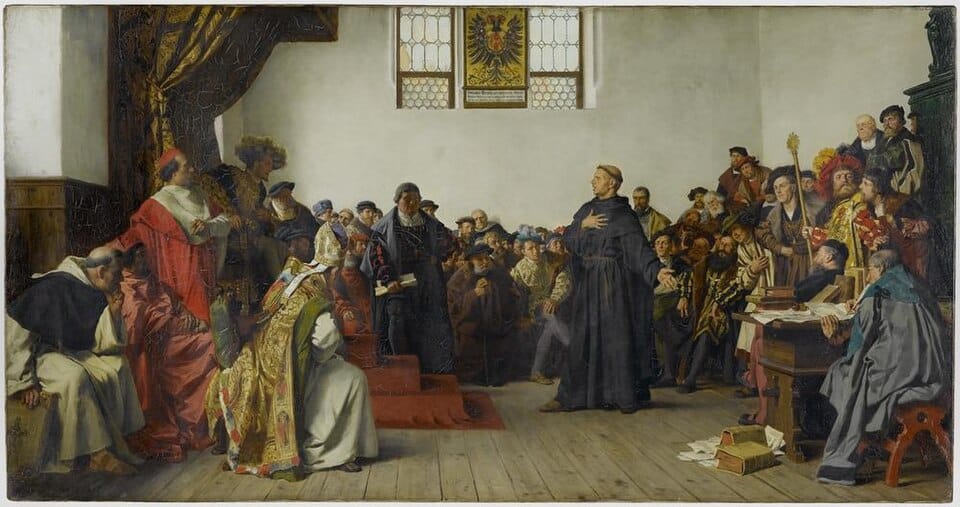
Martin Luther (1483–1546) encouraged such confidence by advising, “The best way to drive out the devil, if he will not yield to texts of Scripture, is to jeer and flout him, for he cannot bear scorn.” The point is not that Satan is imaginary, but that Christians should not give a defeated enemy the fearful fascination he desires.
We should neither trivialize darkness nor tremble before it.
Leave Room for Christian Conscience
But does all of this mean that putting on a firefighter costume and asking the neighbors for a Reese’s cup is participation in the occult?
Not necessarily.
Scripture clearly forbids occult worship and practice. It does not give an explicit command about carving pumpkins, wearing costumes, or collecting candy on October 31. That moves at least some Halloween questions into the realm of wisdom and Christian conscience.
Romans 14 teaches Christians not to judge one another over matters on which Scripture has not bound the conscience. Some believers may participate in ordinary Halloween customs with a clear conscience, while others cannot and therefore should not. Both should seek to honor Christ.
Christian liberty is not freedom to do whatever we please. It is freedom in Christ to obey God joyfully, love our neighbor, and refuse to bind consciences where God has not.
So rather than simply asking, “Do Christians celebrate Halloween?” families might ask:
- What exactly are we participating in?
- What are we teaching our children to fear, laugh at, or admire?
- Are we making genuine evil seem fascinating?
- Does this child have fears or interests that should shape our decision?
- Does participation provide an opportunity to know and love our neighbors?
- Can we do this thankfully before God with a clear conscience?
- If we abstain, are we doing so from faithfulness rather than fear?
Don’t participate without thought. Don’t abstain because of fear.
Our Hope for Our Children
My daughter’s dislike of the Halloween aisle does not settle the question for every Christian family. But the question underneath her reaction is one I hope she never stops asking: Why do we do this?
Our hope for our children is greater than simply raising discerning cultural critics. We want them to know and love Jesus. We want them to understand that sin and death are real, but that Jesus lived, died, and rose again to save sinners. We want them not merely to recognize darkness, but to belong by faith to the One who conquered it and to “walk in the light, as he is in the light” (1 John 1:7).