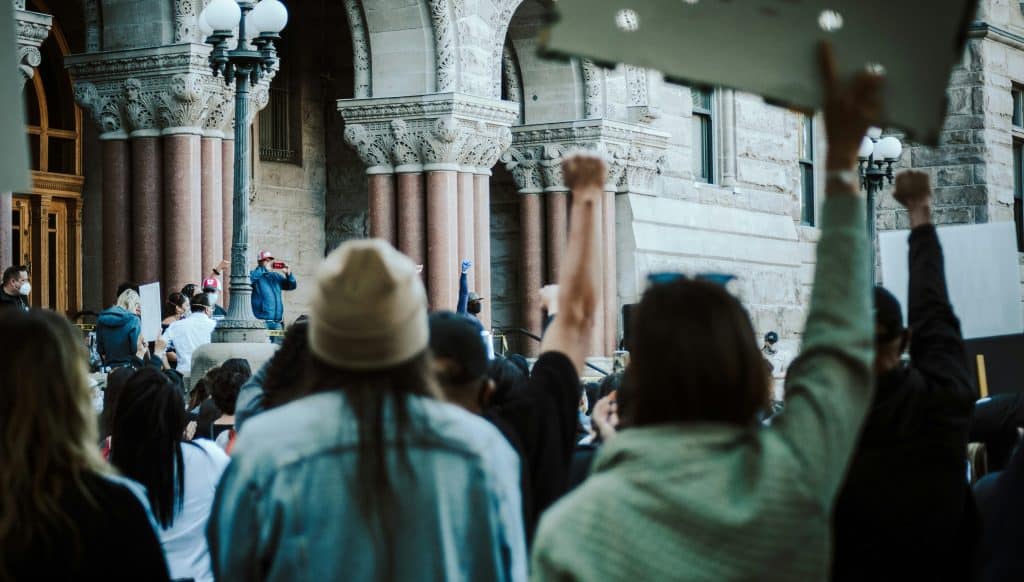
A worship service at Cities Church in St. Paul, Minnesota, was disrupted earlier this month by protesters opposing Immigration and Customs Enforcement (ICE). During the Sunday morning service, activists entered the sanctuary, interrupted the preaching, and unfurled protest messages, forcing church leaders to halt worship. Pastor Jonathan Parnell later explained that “a group of agitators jarringly disrupted our worship gathering. They accosted members of our congregation, frightened children, and created a scene marked by intimidation and threat,” and he called on local, state, and national leaders to protect churches’ fundamental rights.
Church leaders and local officials everywhere should take the time to learn from this incident and understand what churches’ rights are in cases like this because it will happen again, and next time it may be your community, not protest-weary Minnesota. And it may be your church, not Cities Church. That’s because this is an example of an old tactic being revived by the “radical” progressive movement. The tactic is the deliberate targeting of religious worship, and I call it “radical” because it comes from Saul Alinsky’s “Rules for Radicals,” which encourages activists to target institutions with moral authority and create disruptions that polarize rather than seeking consensus.
This means that churches can no longer expect to merely be criticized from the outside and harassed on social media. Instead, their gatherings and campuses will be increasingly treated as fair game for intimidation. Christians of every political persuasion should be concerned, because this strikes at two fundamental social goods: the sanctity of worship and the rule of law that protects it.
An Offense Against God & Good Governance
At the most basic level, disrupting a worship service is an offense against God. The gathered church is not a political rally or a public forum. It is the assembly of God’s people, called together to hear his Word, receive his grace, and offer him praise. Scripture consistently treats the worship of God as holy and worthy of reverence. To intentionally intrude upon that worship for political theater is a desecration. Whatever one’s views on immigration policy, the deliberate disruption of worship crosses a moral line.
Moreover, it is also an offense against civil law. The First Amendment rights of free speech and assembly do not protect the actions of those disrupting worship services on private property. Those rights are subject to time, place, and manner restrictions—and Sunday morning at a church service is not the time nor the place for that manner of protest. On the contrary, the First Amendment does protect the free exercise of religion free from governmental intrusion. In fact, the Constitution, common law, and many state and federal statutes protect the right of believers to gather peacefully and worship without coercion or intimidation, consistent with the rule of law. When protesters enter a sanctuary in America and halt worship, the congregation’s legal rights are being violated.
To intentionally intrude upon that worship for political theater is a desecration. Whatever one’s views on immigration policy, the deliberate disruption of worship crosses a moral line.
Robert Pacienza Share on 𝕏
In the wake of the COVID-19 pandemic when churches across the country were forced to close their doors, eighteen states have passed laws protecting houses of worship from this kind of disruption. My home state of Florida was one of them, which contributed to it being ranked the top state in the nation for religious liberty. In the case of church protests, laws already exist across the country to protect houses of worship from trespass, disorderly conduct, and intimidation—our elected officials simply need to vigilantly enforce them.
A society that cannot or will not protect the freedom of religious worship is no longer embracing the spirit of the First Amendment, and when governing authorities remain silent in the face of such disruptions, they become complicit in the erosion of religious liberty.
That message would be dangerous. History shows that when governments tolerate the intimidation of religious communities, the scope of acceptable disruption expands disproportionately. Consider what happened in the Soviet Union or People’s Republic of China. What begins as a protest becomes a relentless campaign. What is excused as activism becomes normalized lawlessness. If churches in the United States cannot rely on civil authorities to protect their ability to worship freely, then religious liberty has been reduced to a slogan rather than our social contract.
A Christian Response
Christians should take heart, even in the face of such incidents. Christ’s church has endured far greater hostility than this and has flourished precisely when it refused to be intimidated. Christians can, and must, insist that the law be upheld. Holding church-disruptors accountable is an act of justice which believers can reasonably look to our government officials to enforce (Rom. 13:1-7). It protects not only Christians, but also the integrity of a pluralistic society where diverse communities of faith can gather without coercion.
At the same time, believers are called to respond in a manner worthy of the gospel. That means praying for activists, even those who may hate us, while refusing to yield sacred ground to intimidation.
If churches in the United States cannot rely on civil authorities to protect their ability to worship freely, then religious liberty has been reduced to a slogan rather than our social contract.
Robert Pacienza Share on 𝕏
Above all, we must remember whose world this is. “This is my Father’s world,” the hymn reminds us, “and to my listening ears all nature sings.” Even when the mob is ascendant, we must remember that it is Christ who truly reigns. His Kingdom is not, and will never be, threatened by protest signs or Alinsky-inspired tactics. The church’s task in moments like this is to stand, faithfully bearing witness to the Lord Christ.
The disruption at Cities Church is a warning sign. It reveals how fragile religious liberty can become when cultural hostility meets governmental indifference. But let us not forget that it is also an opportunity. An opportunity for Christians to articulate clearly why worship must be protected, why respect for the law matters, and why courage rooted in hope and love is the only fitting response.